

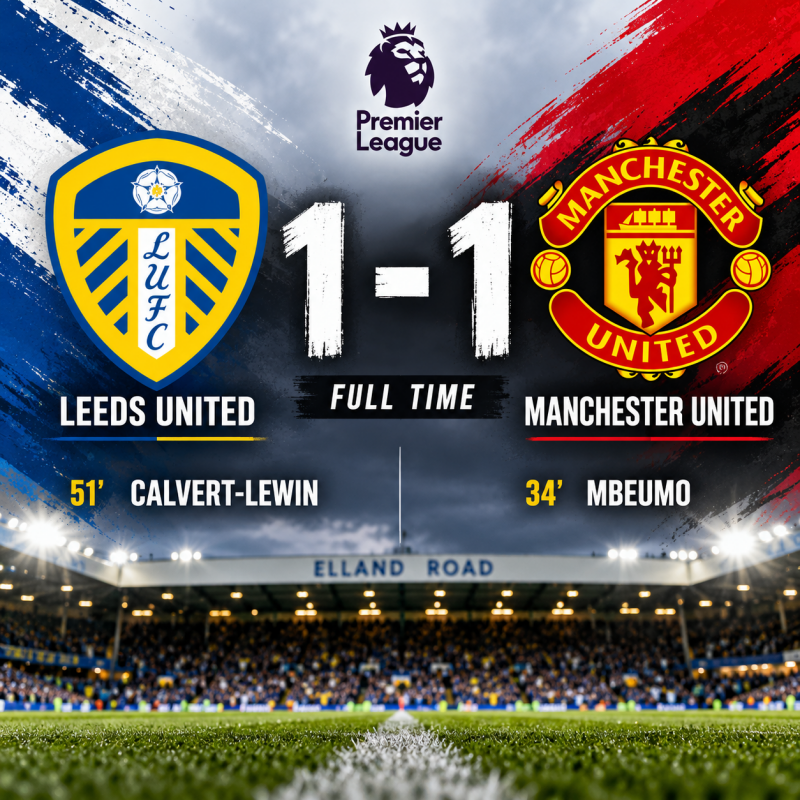
Leeds United 1–1 Manchester United: War of the Roses Ends All Square at Elland Road
Premier League | Sunday 18 October 2026
Just Luvin Football – Match Review
An intense first half, two contrasting goals and a frustrating lack of quality in the final third saw Leeds United and Manchester United share the spoils in a fiercely contested War of the Roses encounter.
The Build-Up: A Rivalry Like No Other
Super Sunday arrived at Elland Road, and with it came one of English football’s fiercest rivalries as Leeds United welcomed Manchester United for another chapter in the historic War of the Roses.
The visitors arrived in Yorkshire under a cloud of uncertainty following a difficult run of form, while Leeds were looking to respond after suffering defeat against Arsenal last weekend.
Daniel Farke’s side had enjoyed an impressive start to their Premier League campaign, but a positive response was needed against their bitter rivals.
There was also a piece of history waiting to be rewritten.
Leeds United had not beaten Manchester United at Elland Road in the league since 2002, when a solitary Harry Kewell goal secured a memorable 1–0 victory.
Despite Manchester United’s struggles, their attacking statistics suggested they remained a dangerous opponent. Heading into the encounter, they had registered 125 shots in the Premier League, more than any other side, alongside 205 touches inside opposition penalty areas.
The numbers suggested Manchester United were creating attacking opportunities, but converting those chances remained a different challenge altogether.
So, would Leeds finally end their long wait for a home victory against their rivals, or could Michael Carrick’s Manchester United silence Elland Road and begin to lift the dark clouds hanging over their season?
As the players emerged from the tunnel, Elland Road erupted.
The famous Marching On Together anthem echoed around the stadium, creating the sort of intimidating atmosphere that Leeds supporters pride themselves on.
The stage was set. The rivalry was renewed. Now it was time for the football to do the talking.
First Half: Physical Battles, Tactical Discipline and a Manchester United Breakthrough
5’ – A frantic opening at Elland Road
What a start!
The opening five minutes delivered exactly what you would expect from this fixture. Fierce tackles, aggressive challenges and an electric atmosphere ensured neither side could establish any meaningful control.
Both teams were desperate to impose themselves physically, with the early exchanges resembling a battle for territory rather than a flowing football match.
7’ – Leeds take control of possession
As the frantic opening began to settle, Leeds United started dictating possession.
Farke’s side moved the ball confidently around the pitch, searching for weaknesses in Manchester United’s defensive structure.
Interestingly, Carrick’s side showed little interest in pressing aggressively.
Instead, they maintained a compact defensive shape, inviting Leeds to have possession before attempting to capitalise on misplaced passes or poor touches.
It was a calculated approach from the visitors.
Manchester United were effectively challenging Leeds to break them down.
The tactical question for Leeds was whether to exploit the wide areas, find openings through midfield or use their movement to disrupt Manchester United’s disciplined defensive organisation.
11’ – Manchester United’s tactical trap begins to work
Leeds were beginning to fall into the visitors’ trap.
Whenever possession was surrendered, Manchester United reacted quickly, looking to launch counterattacks.
In their eagerness to regain the ball, Leeds committed several unnecessary fouls, handing the visitors opportunities from set pieces.
Fortunately for the home side, Manchester United’s delivery from those situations lacked quality.
17’ – Plenty of possession, little penetration
Leeds continued to dominate the ball, but their attacking play remained frustratingly ineffective.
Manchester United looked comfortable defending deep, while the physical nature of the contest prevented either side from establishing a consistent rhythm.
The stop-start nature of the opening exchanges was becoming a defining feature of the match.
20’ – Discipline becoming increasingly important
With yellow cards already being shown, maintaining composure was becoming crucial.
The intensity of the rivalry was evident in almost every challenge, and both sides needed to avoid allowing emotions to dictate their decision-making.
The referee deserves credit for managing a difficult opening period. This was precisely the type of encounter that could quickly spiral out of control.
From a tactical perspective, both managers could identify positives.
Daniel Farke would have been pleased with Leeds’ control of possession, but their lack of attacking penetration was concerning. His side had struggled to properly test Senne Lammens.
Michael Carrick, meanwhile, would have been encouraged by his team’s organisation, physical commitment and willingness to defend collectively.
25’ – Leeds finally test Lammens
A dangerous free kick from Anton Stach provided Leeds with an opportunity.
Nico Elvedi connected with a downward header, which bounced up towards goal, but Lammens reacted well to make the save.
It was a much-needed moment of attacking encouragement for the hosts.
28’ – HUGE CHANCE FOR MANCHESTER UNITED!
Manchester United immediately demonstrated their counterattacking threat.
A perfectly delivered cross found Bryan Mbeumo in a dangerous position, but the forward failed to direct his header on target.
A golden opportunity wasted!
In a game where chances had been limited, that could have proved costly.
30’ – The game begins to open up
The relentless physical battles finally began to settle, allowing both teams to play more expansive football.
Both sides had now created significant opportunities, and the contest was becoming increasingly balanced.
Leeds were finding success in wide areas, particularly through Gabriel Gudmundsson and Jayden Bogle.
Their willingness to drive forward and stretch Manchester United’s defensive shape was becoming a key feature of Leeds’ attacking approach.
At this stage, the match genuinely felt like it could swing either way.
33’ – End-to-end football at Elland Road
The game had suddenly transformed into something resembling a basketball match!
Possession changed hands, attacks developed at pace, and both teams looked eager to exploit the space left behind by their opponents.
Every Leeds attack appeared to invite a Manchester United counterattack, and vice versa.
The intensity was brilliant to watch.
34’ – GOAL! LEEDS UNITED 0–1 MANCHESTER UNITED
BRYAN MBEUMO BREAKS THE DEADLOCK!
Manchester United finally found the breakthrough!
Youri Tielemans advanced down the right-hand side before delivering an excellent low cross into the Leeds penalty area.
Mbeumo reacted brilliantly, getting ahead of his defender and producing a composed finish beyond the goalkeeper.
A superbly executed attacking move from the visitors.
It was a goal that perfectly illustrated Carrick’s tactical approach.
Remain compact, absorb pressure, and when the opportunity presents itself, attack with speed and precision.
Manchester United had executed their game plan to perfection.
39’ – Manchester United growing in confidence
The visitors were producing an increasingly impressive first-half performance.
Their defensive structure remained strong, their tackling was committed, and their attacking transitions were causing Leeds problems.
Despite enjoying plenty of possession, Leeds were struggling to find solutions.
Farke would undoubtedly be looking forward to half-time, when he could reassess his team’s attacking approach.
Leeds had enjoyed moments of promise, but there had been very little genuine quality in the final third.
44’ – Leeds searching for an equaliser
The hosts pushed forward in search of a late first-half response.
However, Manchester United’s defensive discipline continued to frustrate them.
Carrick’s side looked increasingly comfortable protecting their advantage and heading into the dressing room with a one-goal lead.
Half-Time: Leeds United 0–1 Manchester United
Leeds United – Plenty of possession, but where was the cutting edge?
Daniel Farke’s side had controlled significant periods of the first half without making that possession count.
Their biggest problem was the inability to break down Manchester United’s compact defensive structure.
The visitors were not pressing high up the pitch. Instead, they were allowing Leeds to advance before closing spaces and waiting for mistakes.
Leeds needed greater creativity, quicker movement and better decision-making in the final third.
There was still plenty of time to recover, and the hosts had demonstrated enough attacking potential to suggest an equaliser was possible.
However, simply dominating possession would not be enough.
Manchester United – Carrick’s game plan working beautifully
Michael Carrick could have been delighted with his team’s opening 45 minutes.
Manchester United had stood up to the physical challenge, defended collectively and attacked effectively on the counter.
Mbeumo’s well-taken goal was the perfect reward for their tactical discipline.
The challenge now was maintaining that defensive concentration.
An early Leeds equaliser would inevitably lift the Elland Road crowd and potentially transform the momentum of the match.
Carrick needed his players to remain focused, organised and ready to exploit the spaces Leeds would leave behind.
Second Half: Leeds Respond, but Neither Side Finds a Winner
Manchester United made the only change at the interval.
Lisandro Martínez was withdrawn with a suspected injury, with Noussair Mazraoui introduced to partner Harry Maguire in central defence.
50’ – Leeds resume control
The second half began much like the first had developed.
Leeds dominated possession while Manchester United remained content to defend in a compact shape.
The visitors continued to restrict central spaces, encouraging Leeds to attack down the flanks.
It was a familiar tactical picture, but Leeds needed to find a different outcome.
51’ – GOAL! LEEDS UNITED 1–1 MANCHESTER UNITED
DOMINIC CALVERT-LEWIN LEVELS THE SCORE!
ELLAND ROAD ERUPTS!
A Leeds corner caused chaos inside the Manchester United penalty area.
The ball dropped to Dominic Calvert-Lewin amid a goalmouth scramble, and the striker showed excellent composure to control it with his chest before smashing his effort beyond Lammens.
The home supporters exploded into celebration.
GAME ON!
It was exactly the response Daniel Farke needed.
With the scores level, Leeds suddenly had momentum, belief and a passionate Elland Road crowd firmly behind them.
The hosts were also beginning to identify a potential weakness down Manchester United’s defensive right.
Jayden Bogle was enjoying considerable success in his attacking battles, and the defensive reshuffle following Martínez’s withdrawal appeared to offer Leeds an opportunity to exploit.
However, there was still a warning.
As Leeds committed more players forward, they risked leaving themselves vulnerable to Manchester United’s counterattacking threat.
57’ – Leeds turning up the pressure
Since the equaliser, Leeds had taken complete control of the momentum.
Their passing became more purposeful, their movement more aggressive, and their attacking intent considerably stronger.
Manchester United appeared to have lost some of the defensive authority they had demonstrated during the first half.
Everything suggested Leeds were the more likely side to score next.
However, one major concern remained.
Despite their dominance, Leeds had still struggled to create a clear-cut opportunity from open play.
Their equaliser had come from a set piece rather than a carefully constructed attacking move.
The Elland Road crowd had a significant role to play.
If the supporters could maintain the intensity, roar their team into challenges and drive them forward, the atmosphere could become a genuine advantage.
61’ – Time for the managers to influence proceedings
With an hour played, attention began turning towards the technical areas.
Both managers now faced important tactical decisions.
Would Farke introduce fresh attacking options to capitalise on Leeds’ momentum?
Or could Carrick make adjustments to regain Manchester United’s defensive control?
The next substitutions could prove decisive.
65’ – Manchester United weather the storm
Manchester United appeared to have survived Leeds’ initial wave of pressure following the equaliser.
The visitors gradually regained their composure and began showing greater ambition going forward.
Bruno Fernandes remained a constant danger, capable of creating an opportunity from almost nothing.
Leeds could not afford to become careless defensively.
For Farke, fresh legs were becoming increasingly necessary.
Noah Okafor had struggled to make a significant impact, while Ao Tanaka had been caught in possession on several occasions.
Leeds had attacking options available, and introducing greater energy or creativity could help unlock Manchester United’s defence.
From Carrick’s perspective, conceding from a corner would have been disappointing, but there were still positives.
His side had defended effectively in open play, and Leeds had rarely forced Lammens into a truly outstanding save.
70’ – Both managers search for a winner
Manchester United were now beginning to look more threatening.
Their pressing became more selective and effective, allowing them to regain possession and advance towards the edge of the Leeds penalty area.
However, much like their opponents, they lacked the final piece of attacking quality.
The visitors were getting into promising positions without producing the decisive pass or finish.
Farke finally made an attacking substitution, introducing Lukas Nmecha for Noah Okafor.
The change gave Leeds an additional central attacking presence alongside Calvert-Lewin.
Carrick also demonstrated his ambition.
Mason Mount replaced Carlos Baleba, with an attacking midfielder introduced in place of a more defensive-minded player.
Both managers were clearly searching for three points rather than settling for one.
80’ – Attacking quality beginning to disappear
The contest was becoming increasingly frustrating.
Both sides continued to enjoy periods of possession and attacking territory, but neither could find the necessary quality around the penalty area.
The earlier excitement had faded.
Leeds were still capable of winning the match, but their attacking play had become predictable and wasteful.
Manchester United remained dangerous enough to punish a mistake, raising the possibility of a late smash-and-grab winner.
The home side needed to be particularly careful.
For all their possession, one moment of defensive carelessness could undo their hard work.
85’ – Why aren’t Leeds using Bogle more?
One of my biggest frustrations was Leeds’ failure to consistently exploit their right-hand side.
Jayden Bogle had arguably been Leeds’ most influential player throughout the afternoon.
His movement, energy and willingness to take on Diogo Dalot had regularly helped the hosts progress up the pitch.
Yet Leeds had seemingly moved away from an attacking outlet that had caused Manchester United problems.
Whenever Bogle received the ball in advanced positions, Leeds looked more dangerous.
Unfortunately, the quality of the final pass or cross continued to let them down.
It was becoming the defining frustration of their performance.
90’ – Late drama inside the Manchester United box
Leeds launched a long throw into the visitors’ penalty area, causing a moment of uncertainty.
Lammens failed to deal convincingly with the initial delivery, and the loose ball eventually reached Anton Stach.
However, the midfielder could not generate a clean effort, and the goalkeeper recovered to gather the ball.
It summed up Leeds’ afternoon.
Plenty of effort, plenty of attacking territory, but not enough quality when it mattered.
As the final whistle approached, the second half had become a disappointing spectacle compared with the excitement of the opening 45 minutes.
Neither side had done enough to justify taking all three points.
FULL-TIME: LEEDS UNITED 1–1 MANCHESTER UNITED
Post-Match Analysis: A Point Each, but Plenty to Improve
Leeds United – A Missed Opportunity at Elland Road?
For Daniel Farke, this result will probably feel like two points dropped rather than one gained.
Leeds demonstrated encouraging qualities throughout the afternoon.
They controlled possession, responded positively after falling behind and showed real energy immediately following Calvert-Lewin’s equaliser.
However, their attacking performance ultimately lacked imagination and precision.
The biggest concern was their inability to create meaningful opportunities from open play.
For all their possession, Lammens was rarely forced into making a spectacular save.
Leeds’ best attacking moments often came through Jayden Bogle, whose ability to carry the ball forward and stretch Manchester United’s defensive structure caused problems.
Yet the hosts failed to consistently capitalise on those situations.
Manchester United’s defensive reshuffle presented Leeds with an opportunity, particularly with several players operating in adjusted positions.
That was an area Farke’s side should arguably have exploited more effectively.
The introduction of Nmecha offered another attacking option, but Leeds still lacked the creativity required to unlock their opponents.
My assessment: Leeds will be pleased with their resilience and their ability to respond after conceding, but their final-third quality must improve.
This was a game they had a genuine opportunity to win, especially in front of their own supporters.
Possession without penetration will only take a team so far.
Manchester United – Defensive Resilience Offers Carrick Encouragement
Michael Carrick will undoubtedly take positives from his side’s performance.
Manchester United’s first half was tactically impressive.
They arrived at a hostile Elland Road, stood up to the physical challenge and demonstrated excellent defensive organisation.
Their approach was clear.
Allow Leeds possession, maintain a compact defensive structure and attack quickly whenever opportunities emerged.
Bryan Mbeumo’s opening goal was an excellent example of that strategy working effectively.
The second half was less convincing.
Manchester United struggled to maintain their attacking threat, and the equaliser from a corner was a disappointing moment after defending so effectively in open play.
Nevertheless, the visitors deserve credit for weathering the pressure that followed.
They did not collapse when Elland Road erupted, and they gradually worked their way back into the contest.
Their defensive resilience, particularly during the closing stages, was encouraging.
However, the lack of quality in the final third remains a concern.
My assessment: Carrick can be satisfied with the defensive commitment and tactical discipline shown by his players.
Manchester United demonstrated that they can compete in an intense atmosphere and remain organised under pressure.
But if they are to turn performances like this into victories, they must become more clinical and creative in attacking areas.
With a Champions League encounter against Como approaching in midweek, there are positives to build upon.
Just Luvin Football – Man of the Match- Jayden Bogle (Leeds United)
My Man of the Match goes to Jayden Bogle.
In a game where attacking quality was often lacking, Bogle consistently provided Leeds with an outlet down the right-hand side.
His willingness to drive forward, take on defenders and support attacking moves was one of the most encouraging aspects of the home side’s performance.
He regularly looked capable of getting the better of his direct opponent and was instrumental in helping Leeds progress into dangerous areas.
Defensively, he also worked tirelessly, showing the energy and commitment required in such a fiercely contested rivalry.
For me, Leeds looked at their most threatening whenever Bogle was involved.
His contribution at both ends of the pitch was hugely important, and his consistent effort deserves recognition.
Just Luvin Football MOTM: Jayden Bogle.
Final Thoughts: The War of the Roses Ends in a Stalemate
This was a match of two very different halves.
The opening 45 minutes delivered everything you would expect from a fierce Premier League rivalry.
There were crunching tackles, tactical battles, dangerous counterattacks and a fantastic atmosphere.
Manchester United deserved credit for executing their first-half game plan, with Mbeumo’s goal providing the perfect reward.
Leeds responded brilliantly after the interval, and Calvert-Lewin’s equaliser appeared to set the stage for a thrilling second half.
Unfortunately, the match never quite reached those heights again.
Both teams lacked creativity, composure and quality in the final third, resulting in a frustrating conclusion to what had initially promised to be an excellent encounter.
Leeds will feel they missed an opportunity to claim a long-awaited home victory against their rivals.
Manchester United, meanwhile, can take encouragement from their defensive performance and ability to handle the Elland Road atmosphere.
Ultimately, a draw was probably the fairest outcome.
The War of the Roses produced plenty of passion, but neither side found the quality required to claim the bragging rights.
Add comment
Comments